Simple is never easy: what I’ve learned from Loli Flores’ Seguiriya
I don’t usually learn choreographies or even singular steps from YouTube. Choreographing from scratch is one of my favorite things to do! But, over the holiday break, I started to learn a seguiriya with castanets by Loli Flores.
It all started because I couldn’t decide what other solos to dance along with my tientos for an upcoming regional tour, and somehow seguiriya with castanets came to mind. I’m not exactly a castanet expert, so I wanted to get some inspiration and searched on YoutTube, and a few versions of Loli Flores dancing seguirilla with castanets came up. I selected the oldest video available.
I watched the video a couple times through. It’s so clean, clear, and simple. I showed it to my husband, “Do you think I can learn this?” “There’s a lot of side to side movement. Sure, why not.” I think I asked him because I knew it looked simple, but I also knew there was a lot more to it than there seems at first glance, though I was thinking the castanets would be the big hurdle.
And so, I started in. Here’s what I’ve learned so far in the process:
First, palillos (castanets) with bata. For years I had to dance a solo with palillos in a bata on tour with Flamenco Vivo. I don’t consider myself a great castanet player. I never quite got the solo down, except for one performance. One day on tour, because of shortening the first scene, instead of the usual decades old, very heavy red bata I usually wore for the piece, I had on a much lighter bata. And the solo sounded so good for once!!! It was the bata - not my castanets. But I never figured out how to have that ease with the ten pound (or more) bata dragging behind me.
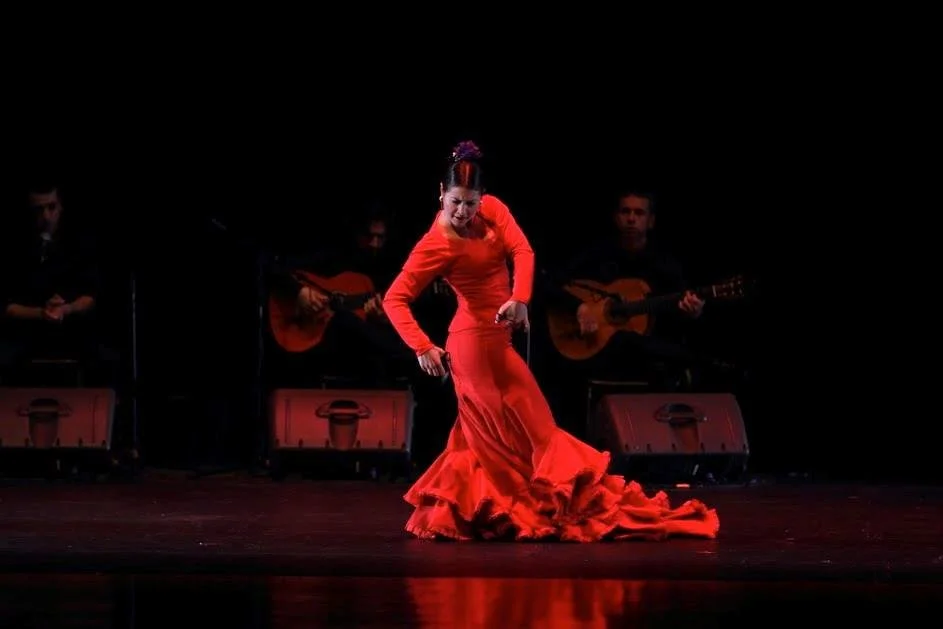
PC: Robert Cort, courtesy Flamenco Vivo Carlota Santana
Well, here I am, more than ten years later, and as I’m trying to time the walks forward with the bata just like Loli, I realize I’m letting the bata drag me, and the castanet playing. I start moving from my pelvis instead of my feet, I lean my upper body slightly forward - boom! It all clicks, I can move with ease, I feel like I’m floating. And my castanets sound more clear somehow in that subtle shift of where each step initiates. Now I can focus on my castanet sounds and accents with ease.
Next, I noticed how Loli moves her hips to hold the tension and musicality. I don’t usually think of seguiriya being a musical style with much hip movement, but the way she does it captures seguiriya’s feel. So much control and tension, and the movement is so, so small and subtle (See 2:15 & 3:15 and many other places). When I watch videos these days of contemporary flamenco artists, dancing is so flashy, energetic, big, and flamboyant. From excessive turning of the head back and forth to crazy fast footwork, big kicks - maybe the subtlety is still there in other parts of the dance, but the clips that circulate the social media reels are flashy as can be. And those viral moments do get our attention, and sometimes are impressive. But Loli’s slow tiny hip movements are far more powerful in my opinion.
Once I had the marcajes (more or less) from the first letra, it was on to the first escobilla. It’s relatively straightforward - no fancy or over-fast patterns. A standard step in seguiriya to start it off, then a long subida that starts on one foot, goes to two feet, then travels. It is the hardest escobilla I have learned because of the amount of strength it requires. And I can only imagine her doing it with a bata probably twice as heavy as the one in which I practice.
First, the transition into the subida is a series of redobles - several sounds condensed into a few beats. This takes a lot of power in the legs and abdominal strength. Then, for several measures, she stays on just one foot. The strength, especially in the supporting heel and stabilization muscles of the legs is extraordinary - to achieve that rhythmic precision on one leg for so long! Then, traveling, big steps in a circle with a subida, while holding the bata. Whew!!! It’s super human what she does. And that’s just the first escobilla.
Whether I end up performing the solo or not, it’s changed the way I think about flamenco training. The rigor of training to get to Loli’s level is tremendous. To hold the command of the space in the slow and simple movements, or the slow control of the hips, takes a level of engagement of the whole body, every cell - a presence of mind, body, and spirit. I appreciate the simple but powerful old school steps even more now.
I’m accustomed these days to being very aware of how intellectually challenging flamenco is - to actively listen and make choreographic decisions in the moment. But, I think I’d forgotten how physically demanding flamenco training ought to be, and the amount of repetition required to build stamina. Working from this video has brought a renewed rigor to both my own practice and my teaching, and deepened my appreciation for the art form and especially the “old school.” Simple is very rarely easy; simple is both strength and distillation. A good sherry, not a cheap wine with a flashy label.